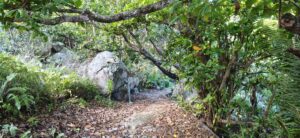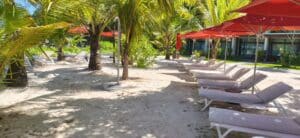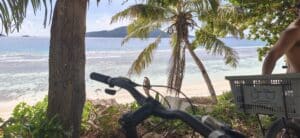

In the Seychelles, the journey is not only experienced once you arrive on the beach.
It starts earlier.
In the sky.
On a pier.
At ferry boarding.
Awaiting departure.
The moment an island slowly drifts away behind one.
Or when another appears, green and luminous, in the middle of the Indian Ocean.
A holiday in the Seychelles is often imagined as a succession of perfect beaches, turquoise lagoons and postcard-like scenery.
However, the archipelago is also understood in movement.
Between Mahé, Praslin, La Digue and Silhouette, crossings are not mere logistical details. They are part of the experience. They change the pace, prepare the gaze, create transitions and give the journey that very particular feeling of moving from one atmosphere to another.
In the Seychelles, you don't just move from one island to another.
Let's cross.
Arriving by air
There is first the arrival.
Even before setting foot on the archipelago, something is already happening on the plane.
When the first islands appear below the clouds, the destination begins to take shape. The blue changes shade. The turquoise lagoon stands out from the deeper blue of the ocean. The landforms emerge. The outlines of the islands gradually trace a first mental map.
This moment is often more powerful than one imagines.
Because it's not just about a landing.
This is the first encounter with the archipelago.
From the sky, the Seychelles reveal themselves as a dispersed world, surrounded by water, light and vegetation. The traveller immediately understands that they are not arriving at a compact destination, but in an insular territory where every journey will have its importance.
Flight is therefore not merely a means of access.
He is already building the emotion.
It prepares the eye for what is to come: a journey made of islands, passages, periods of waiting, horizons and changes of pace.
Mahé, first breath of the archipelago
Arriving in Mahé often provides the first real contact with the Seychelles.
The airport, the tropical heat, the proximity of the sea, the roads, the first houses, the relief in the background: everything reminds us that Mahé is not just an island of arrival or departure.
It is also the main island, vibrant, inhabited and contrasting.
The journey can then take several directions.
Stay in Mahé for a few nights to discover its beaches, mountain roads, cuisine, trails and local life. Or quickly head to another island, by sea or by air, to continue the multi-centre trip.
In any case, Mahé often acts as an anchor point.
She introduces the journey.
She connects it.
It allows you to switch to the other atmospheres of the archipelago.
And it is often from Mahé that this sensation of movement peculiar to the Seychelles truly begins.
The pier, a place of transition
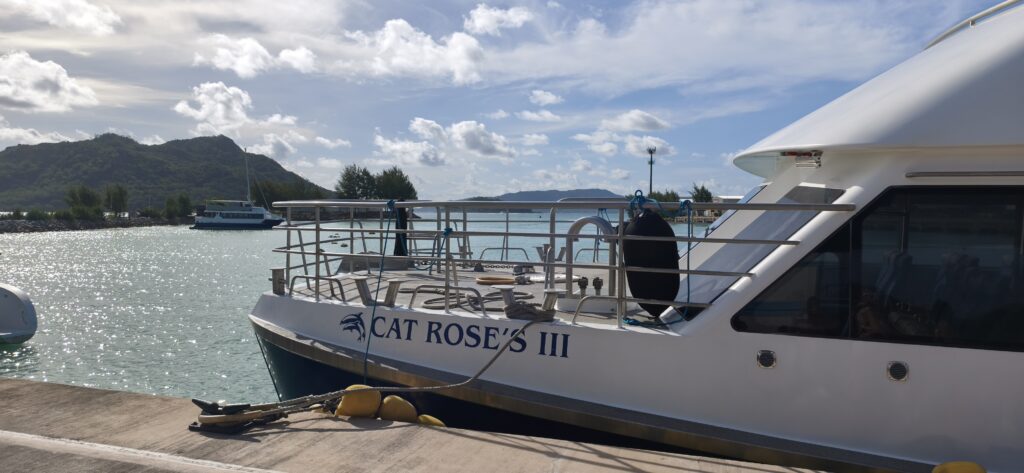
There is something very special about Seychellois jetties.
You cross paths there with travellers, locals, luggage, freight, loading teams, families, staff, and tourists still in transit between two legs of their journey.
The jetty is not merely a place of waiting.
This is a place where the archipelago shows that it is alive.
You can feel the connection between the islands there.
It shows the discreet logistics that make the journey work.
We understand that the Seychelles are not merely a dream image, but also a territory organised around the sea.
The wait before the ferry is already part of the story.
We are looking at the boats.
We are looking at the luggage.
You can smell the sea air.
You leave one island without yet having quite arrived at the next.
It is a grey area.
And on an island journey, these in-betweens matter a great deal.
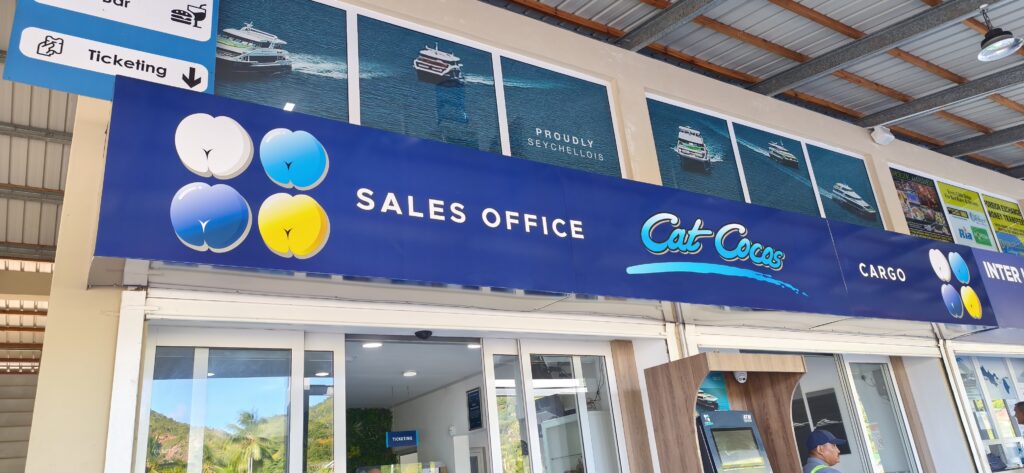
Cat Cocos: the crossing as a passage
Between Mahé and Praslin, the Cat Cocos crossing takes about an hour and a quarter.
It is a short enough duration to remain comfortable, but long enough to feel the change.
Mahé moves away.
The ocean takes up more space.
Blue changes according to the light.
The tempo gradually slows down.
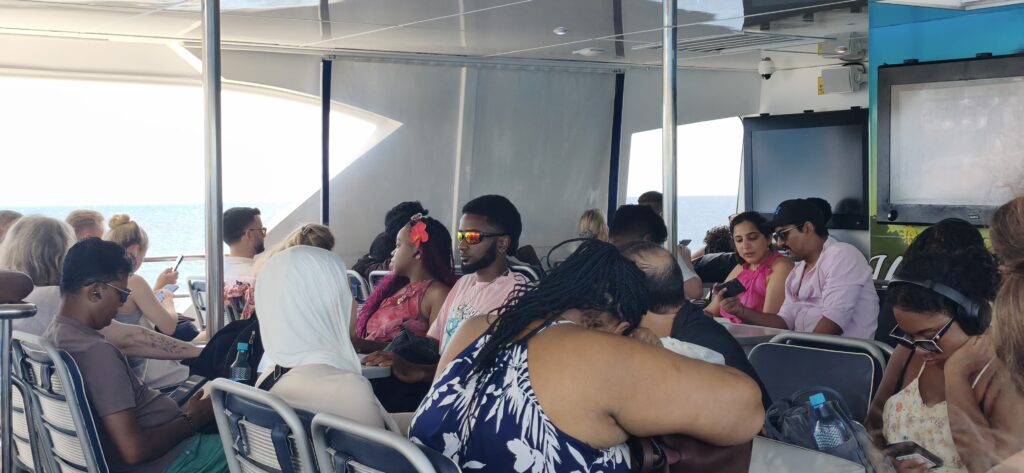
The ferry is often seen as a simple means of transport. Yet, it can become a real part of the journey.
On board, you are no longer really on the previous island.
We're not in the next one yet.
It hovers between two atmospheres.
This crossing is wonderful preparation for arriving in Praslin.
We leave Mahé, which is livelier, busier with roads and more populated. We reach an island that seems gentler, more laid-back, more immediately tropical.
Movement is therefore not neutral.
He is transforming the perception of travel.
A more structured organisation than one might think
Inter-island crossings in the Seychelles must not be thought of as mere improvised shuttles.
On the ground, the way the ferry operates is more reminiscent of a small airport procedure: ticket presentation, check-in, luggage drop-off, security check, boarding, and then departure at a precise time.
For the traveller, this arrangement is reassuring.
It gives the impression that the connections are structured, legible and suited to island-hopping itineraries.
But it also requires planning the right pace.
You need to arrive early.
Allow time for baggage.
Keep to the timetable.
Avoid overly packed schedules.
Do not treat a transfer as a mere invisible detail in the day.
That is an important distinction.
Because a successful Seychelles island-hopping trip isn't built just with beautiful islands and good hotels. It is also built with comfortable transitions.
Praslin: arriving in another kind of gentleness
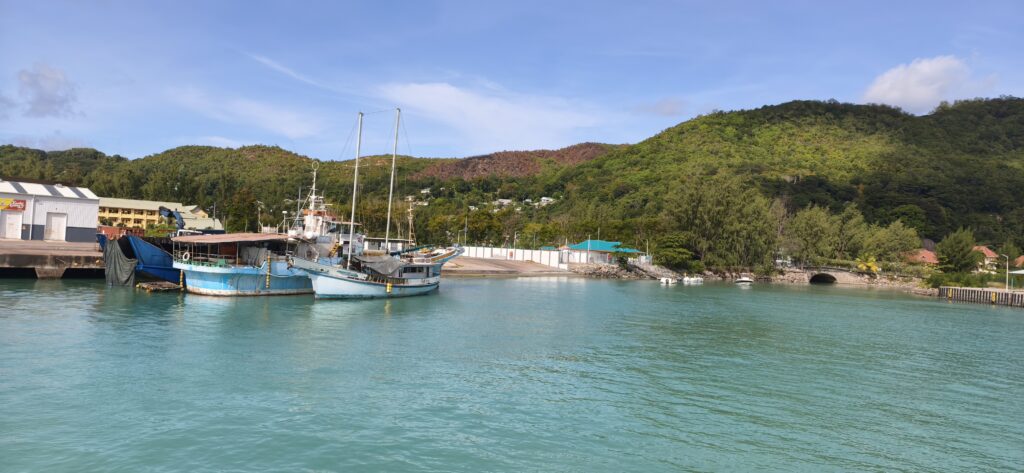
Arriving in Praslin immediately changes the atmosphere.
The island seems softer.
Calmer.
More seaside-like too.
The crossing gives way to another pace: sunlit beaches, tropical nature, the Vallée de Mai, intimate hotels, a more relaxed atmosphere.
Praslin is often an island of balance in a Seychelles island-hopping holiday.
It allows you to enjoy the beach without giving up nature. It makes it easy to explore La Digue. It offers a breather after Mahé and a pleasant base to settle the trip.
This is where the movement takes another form.
After the sea crossing, we slow down.
We're getting settled.
We are looking at the light.
We're enjoying a lagoon.
We let the destination become softer.
La Digue: a few minutes to change your world
From Praslin, getting to La Digue is much quicker.
The crossing is short, around fifteen to twenty minutes.
And yet, the change in atmosphere is very clear.
La Digue doesn’t need a long journey to create a sense of detachment. It imposes its rhythm almost immediately.
Fewer cars.
More bikes.
Paths.
Granite beaches.
A sense of accessible slowness.
An island that is best experienced on foot or by bicycle.
That is what makes La Digue so memorable.
The journey from Praslin is straightforward, but the experience there is very different. The transfer is therefore not just about the boat. It continues in the way you get around once you have arrived.
The traveller must accept a different pace.
In La Digue, you don't just visit an island.
We're changing pace.
When travel becomes an experience
In the Seychelles, every mode of transport tells a story.
The aeroplane gives the first emotion of the archipelago.
The ferry gives the feeling of passage between the islands.
The bicycle reflects the simplicity of La Digue.
The electric buggy evokes the calm of Silhouette.
The mountain road in Mahé is a reminder that the island is not just a seaside destination.
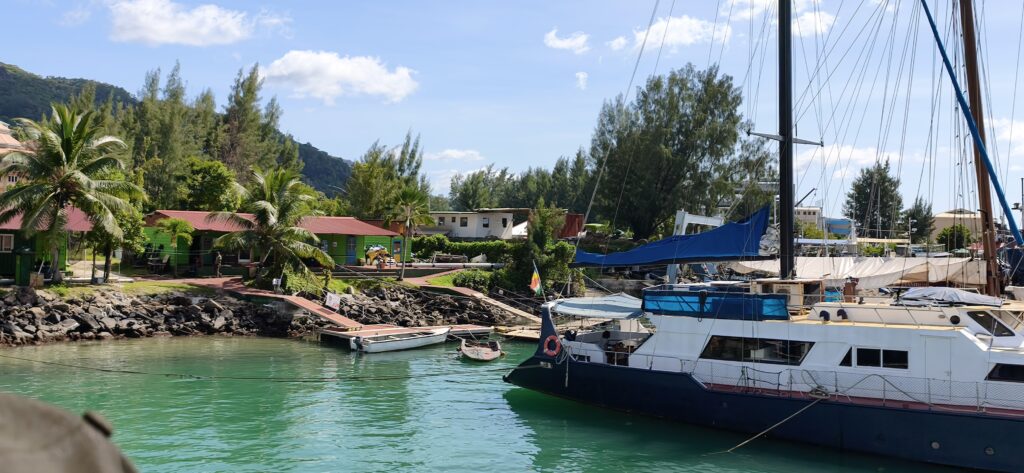
The pier shows the destination in motion.
These journeys must not be considered as downtime.
They can become highlights, provided you don't just endure them.
It all depends on the chosen pace.
A transfer that is too tight is tiring.
A well-placed pass adds meaning.
A crossing done too quickly can create stress.
A crossing integrated into the narrative of the journey becomes a breather.
That is the whole difference between a packed itinerary and a well-planned trip.
Silhouette: the crossing to calm
Silhouette illustrates this idea perfectly.
From Mahé, you need to go to Bel Ombre / Labriz Jetty, then embark for a crossing of around forty-five minutes.
This boat time is not a secondary constraint.
He is preparing the experiment.
Little by little, Mahé moves away.
The journey is becoming calmer.
Silhouette Island appears as a greener, more secluded, more intimate mass.
Upon arrival, the pace changes again.
Electric buggy transfer.
Quieter atmosphere.
Very little traffic.
Ubiquitous nature.
Forest, paths, ocean, biodiversity, slow travel.
Silhouette does not see itself as just another island.
She chooses herself as a parenthesis.
And the crossing is part of that hiatus.
Do not rush from one island to another
The danger with a Seychelles twin-centre holiday is trying to do too much.
Add Mahé.
Add Praslin.
Add La Digue.
Add Silhouette.
Changing hotels frequently.
Increase the number of crossings.
Doing early departures one after another.
On paper, the route looks complete.
Once there, it can become too fragmented.
Every journey takes time.
Every transfer uses energy.
Each change of island requires repacking bags, leaving a room, keeping to a schedule, waiting, boarding, disembarking, and getting to new accommodation.
That is not negative.
It's simply the reality of an archipelago.
And this reality must be integrated into the construction of the journey.
In the Seychelles, the best holiday is not necessarily the one that shows the most islands.
It is the one that gives every island the time to exist.
Transfers as respiration
A good transfer can become a breath of fresh air.
It allows you to leave one atmosphere before discovering another.
Mahé to Praslin: moving from the main island to a more tropical laid-back vibe.
Praslin to La Digue: leaving a comfortable base for a simpler, slower, more iconic experience.
Mahé to Silhouette: moving away from the hustle and bustle and entering a haven of peace and nature.
These passages structure the narrative of the journey.
They give the stay a progression.
They prevent the islands from simply being aligned one after the other.
On a well-thought-out journey, every transfer has a purpose.
He doesn't just tick a logistical box.
It accompanies the change of atmosphere.
Choosing the right island order
The order of the islands strongly influences the feeling.
Starting with Mahé can be a gentle way to ease into the destination, discover a livelier island and adapt to the tropical rhythm.
Continuing to Praslin brings a more seaside ambience, between beach, nature and relaxed hospitality.
Adding La Digue brings a simpler, more visual sequence that is very powerful in the imagination.
Ending with Silhouette can offer a form of withdrawal, calm and disconnection before the return.
But this order is not a rule.
It all depends on the traveller's profile, the total length of the stay, hotel availability, timetables, preferences and tolerance level for transfers.
The main thing is not to build solely with a map.
We need to build at the client's pace.
Comfort is not just about the hotel
On a trip to the Seychelles, comfort does not depend solely on the room, the beach or the level of service.
It also depends on the smoothness.
A customer who doesn't run profits more.
A client who understands their transfers experiences them better.
A guest who has the time to arrive, settle in and breathe keeps a more pleasant perception of their stay.
Comfort is sometimes found in a planned buffer time before a ferry.
On a final well-placed night in Mahé.
On a less busy day after a crossing.
In choosing not to add yet another island when the stay is too short.
These are details that are invisible in the photos.
But they profoundly change the experience.
Island hopping
The Seychelles are a landscape destination, of course.
But they are also a destination for passers-by.
To come down to earth.
From a pier to a boat.
From a ferry to a beach.
From a living island to a slower island.
From a mountain road to a lagoon.
From a tropical rainforest to a granite beach.
From a boutique hotel to a more intimate address.
It is this succession of transitions that gives the journey its depth.
Crossings are not only what connect islands.
They form part of what sets them apart.
In conclusion
In the Seychelles, movement is part of the journey.
The ferry, the plane, the piers, the roads, the bikes and the crossings are not just means of transport. They are moments of transition between different atmospheres.
They allow you to experience the diversity of the archipelago.
Mahé is not like Praslin.
Praslin is not experienced like La Digue.
La Digue doesn't have the same pace as Silhouette.
And it is precisely this diversity that makes the Seychelles so interesting to build.
A great multi-centre holiday isn't about rushing from island to island.
It involves making sure every move prepares for the next.
To understand that the journey is found not only in the places where one arrives, but also in the moments when one passes from one to another.
In the Seychelles, between two islands, the journey continues.
To check before departure: Travel advice and Travel formalities.
Find out more : Seychelles Tourist Office