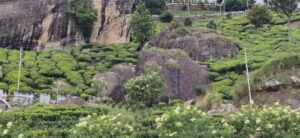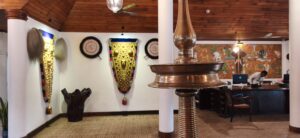


There comes a moment, during a trip to South India, when the landscape seems to suddenly catch its breath.
After the heat of the plains, the bustle of the cities, the markets, the monumental temples and the fervour of Madurai, the road begins to climb. The bends become more numerous, the vegetation grows denser and the air changes almost imperceptibly.
Then green invades everything.
It covers the valleys, the mountains and the forests. It sketches the tea plantations with almost unreal precision. It accompanies the mist, absorbs sounds and progressively transforms the rhythm of the journey.
Munnar thus appears, not as a break from India, but as another way of experiencing it.
A cooler India.
More plant-based.
Quieter.
An India that no longer seeks to impress with the monumentality of its temples, but which simply invites you to look at the hills, breathe the humid air and let time slow down.
Leaving Madurai and feeling the journey change
The route between Madurai and Munnar is sometimes presented as a simple transfer.
Yet it constitutes one of the most striking passages of a route combining Tamil Nadu and Kerala.
Initially, the world of Madurai is still very much present. The city awakens in the heat, the streets remain lively, and images of the Meenakshi Temple continue to accompany the traveller: the gopurams covered in sculptures, the colours, the offerings, the crowds, and that spiritual intensity that seems to inhabit every space.
Then the buildings become more spaced out.
The road passes through villages, runs alongside small shops and reveals everyday scenes. Stalls appear by the roadside, with their fish, flowers, herbs, baskets and bright colours.
India is shown here without any staging.
She is direct, lively, sometimes disorienting. She is discovered as much through images as through sounds and smells.
But little by little, the landscape draws closer.
The road begins to climb and the landscape changes its texture. Banana trees, bamboo, ferns and tropical trees become more numerous. The valleys deepen, the forests grow thicker and the temperature gradually drops.
The transition from Tamil Nadu to Kerala is then no longer merely an administrative border.
It can be felt in the air, the light, and the colours of the landscape. The mountain road, which takes about four to five hours depending on the conditions, becomes a true transition between two worlds.
When the first plantings appear
Tea plantations don't always reveal themselves immediately.
They appear gradually, around a bend in the road, as if the mountain were waiting until the last moment to reveal its most iconic landscape.
The first few rows still seem unobtrusive.
Then they multiply.
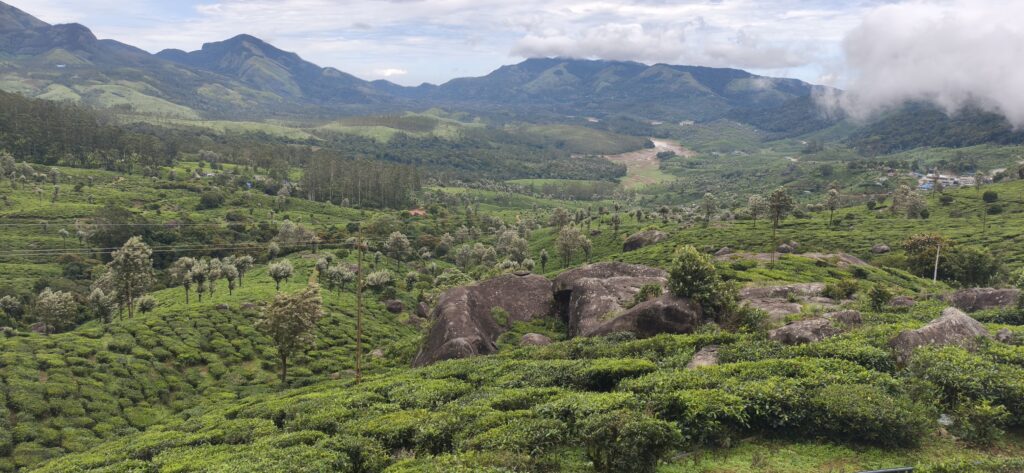
The tea bushes follow the curves of the land, hugging the slopes and transforming hillsides into immense graphic tapestries. From afar, the landscape resembles a fabric of vegetation perfectly tailored to the mountains. Up close, it reveals thousands of meticulously tended plants, separated by narrow paths.
The light plays with the different shades of green.
Sometimes, the sun lights up one patch while neighbouring hills disappear under clouds. A few minutes later, the mist rolls in and erases part of the landscape.
Munnar never allows itself to be observed in a completely fixed way.
The mountain evolves with the sky.
She appears, conceals herself, draws near then seems to move away again.
This instability is part of its charm. It forces you to slow down and accept that not all panoramas will reveal themselves at the planned moment.
A breath in the heart of the circuit
Munnar holds a special place in a South India trip.
It's not just a natural stop between Madurai and Periyar. It provides an indispensable balance to the entire itinerary.
Before her, travel is often dominated by stone, temples, cities, ceremonies and a strong cultural intensity.
In Munnar, the gaze travels further.
The spaces open up.
The climate is getting milder.
Silence is reclaiming a space we had almost forgotten.
This pause doesn't mean the journey becomes any less rich. It simply offers another form of discovery.
The sculptures of a gopuram are no longer deciphered.
We observe the curve of a plantation.
The bells of a temple are no longer heard.
Attention is paid to the wind, the birds, and the sound of the rain on the leaves.
You no longer walk through a dense crowd.
We are following a narrow road that winds between the mountains.
The sales dossier for the itinerary precisely presents Munnar as the passage between cultural Tamil Nadu and natural Kerala: a stop for freshness, tea, mountains, and calm, particularly useful for rebalancing the pace of the journey.
Tea, far more than a backdrop
In Munnar, tea is everywhere.
It shapes the landscapes, accompanies the roads and profoundly participates in the identity of the region.
However, it would be a shame to limit this presence to a few photographs taken from a panoramic viewpoint.
Behind the perfectly sculpted hills lies a whole universe of culture, harvesting, and transformation.
A visit dedicated to tea allows one to move from the landscape to the product. The fresh leaves, the drying stages, the machinery, the smells and the movements suddenly make concrete what seemed to be just an immense botanical composition.
The cup enjoyed at the end of the course then no longer has quite the same meaning.
It brings to mind the slopes, the dampness, the work on the plantations, and the various transformations required before the leaves reach us.
In the region, this discovery can take on a particularly sensory dimension, with flavours evoking cinnamon, cardamom or ginger in particular.
Tea is no longer just for drinking.
It tells of the territory.
It connects the mountain, the know-how, and the memories of the journey.
The beauty of silent hours
Munnar can also be discovered during times when nothing is officially planned.
In the morning, when the hills slowly appear from behind the mist.
At the end of the day, when the light becomes softer and the mountains change colour.
On the edge of a terrace, when you're simply holding a warm mug between your hands.
These moments don't always feature on the itinerary, but they often give a stay its true depth.
In a routine dictated by departures, visits, and transfers, luxury sometimes means no longer looking at the time.
To stay a few extra minutes looking at the scenery.
To watch a cloud descend over the plantations.
To listen to the silence without immediately trying to fill it.
Munnar possesses that rare ability: it makes natural contemplation.
You don't feel the need to multiply activities to feel like you're fully experiencing the destination.
The scenery is sometimes enough.
Sleeping amidst the greenery
The choice of accommodation plays a vital role in a region like Munnar.
A hotel situated in an open, mountainous setting allows the experience to linger long after the sightseeing is over.
The traveller doesn't truly leave the destination when they retire to their room. They continue to see the landscapes, feel the coolness, and observe the changes in light.
Beautiful gardens, a terrace facing the hills or a swimming pool overlooking the mountains can thus become much more than simple amenities.
They allow us to inhabit the landscape.
After several culturally intense days, this continuity between the stopover and the accommodation provides a real sense of rest.
Comfort does not interrupt immersion.
It gives it another shape.
In the evening, the mountain becomes darker and more mysterious. In the morning, it sometimes reappears covered in clouds. In between, Munnar offers the traveller the opportunity to slow down enough to become aware of the journey taken from the plains of Tamil Nadu.
Accept the mist and rain
Munnar is located in a mountain region where the climate can change rapidly.
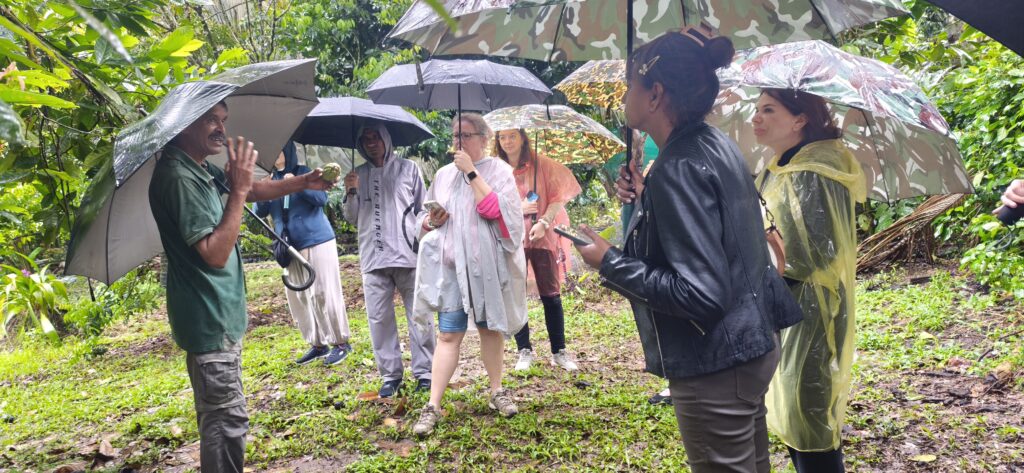
The light is changing, the temperature is dropping, and rain can appear without warning.
For some travellers, this weather might seem to thwart the ideal image of plantations under a perfectly blue sky.
Yet she fully participates in the atmosphere of the place.
In the rain, colours become deeper. Leaves glisten, the earth gives off a more intense scent and mist descends on the landscape.
The mountain then seems even more enveloping.
You should naturally pack a light jacket, good shoes, and be prepared for the possibility that some views might be partially obscured. The road, often winding, should also be anticipated by those sensitive to journeys at altitude.
But this element of the unexpected does nothing to detract from the experience.
She simply recalls that Munnar is not a static backdrop.
It is a living territory, subject to the rhythm of the mountains, the clouds and the seasons.
A step to live more slowly
In a short itinerary, Munnar can sometimes be passed through too quickly.
An arrival at the end of the day, one night, a few photographs, then an early departure for Periyar.
However, the destination warrants more time when the programme allows.
An extra night offers the chance to enjoy the scenery without rushing, to discover the world of tea more peacefully, and to allow for proper rest.
This extension is particularly interesting for travellers who appreciate nature, photography, or slower-paced tours.
It is also suitable for those who wish to balance major cultural milestones with more contemplative times.
Munnar doesn't necessarily demand more activities.
She is mainly asking for more availability.
Time to watch.
Time to understand.
Time for doing nothing.
The last look before Periyar
Then comes the time to leave Munnar.
The road continues through plantations and mountain landscapes. Gradually, the tea gives way more to tropical forest and spice crops.
Cardamom, pepper, cinnamon and ginger herald a new facet of Kerala.
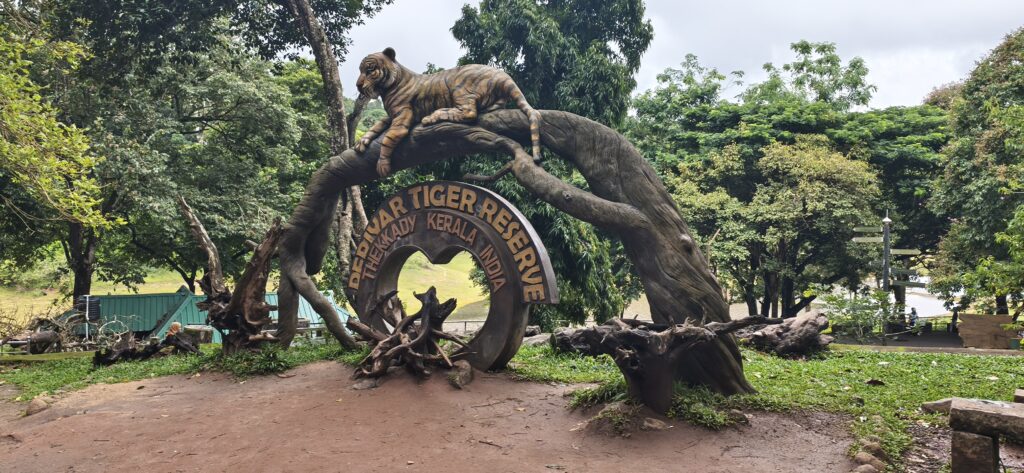
The journey heads towards Periyar, its lake, its dense vegetation, and its wilder atmosphere.
But Munnar still remains present for a long time.
In the cool of the morning.
In the green lines of the plantations.
In the scent of tea.
In the mist glimpsed between two reliefs.
It acts as a gentle, yet essential, transition between the temples of Tamil Nadu and the Kerala of forests, spices, and water.
Southern India, otherwise
Munnar recalls that India does not have a single face.
It can be burning, monumental, and vibrant.
To become fresh, silent, and covered in tea.
She can impress with the fervour of a temple.
Then be moved by the mere appearance of a hill behind the mist.
It is precisely this diversity that makes a route between Tamil Nadu and Kerala so powerful.
The journey never repeats the same sensation.
It changes pace, colour, and atmosphere.
In Munnar, he rediscovers his breath.
And the traveller then understands that silence is not an absence.
There is another way to listen to the destination.
A break to discover on the itineraries devised with Namaskar India Tour, to get close to South India in its most unexpected aspects: mountains covered in tea, almost cool air and that rare feeling that, for a few hours, time has decided to slow down.
To check before departure: Travel advice and Travel formalities.
Find out more : Namaskar India Tour