

There are moments of travel that impress with their grandeur, their history or their spectacular beauty.
And then there are others that stick in the memory for an almost opposite reason: because, suddenly, nothing more happens that needs to be rushed.
The backwaters of Kerala belong to this second category.
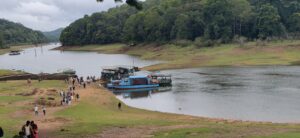
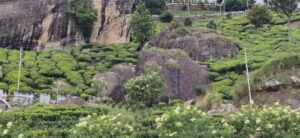
After several days crossing Southern India, from the monumental temples of Tamil Nadu to the tea plantations of Munnar, and then on to the forests and spices of Periyar, the road descends gradually towards a different landscape.
The mountain is moving away.
The horizon opens.
Water appears.
And with her, the pace of the journey changes.
In Alleppey, boarding a houseboat is not simply stepping onto a vessel to reach a new destination. It is agreeing, for a few hours and a night, to let Kerala come to you.
From road to water, an almost immediate change
In the morning, we leave the plant world of Periyar once again.
The roads wind between the plantations, the villages and that dense greenery that accompanies a large part of Kerala. Then, little by little, the landscape flattens out and the territory seems to begin to breathe differently.
The canals appear.
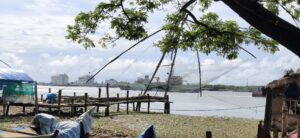
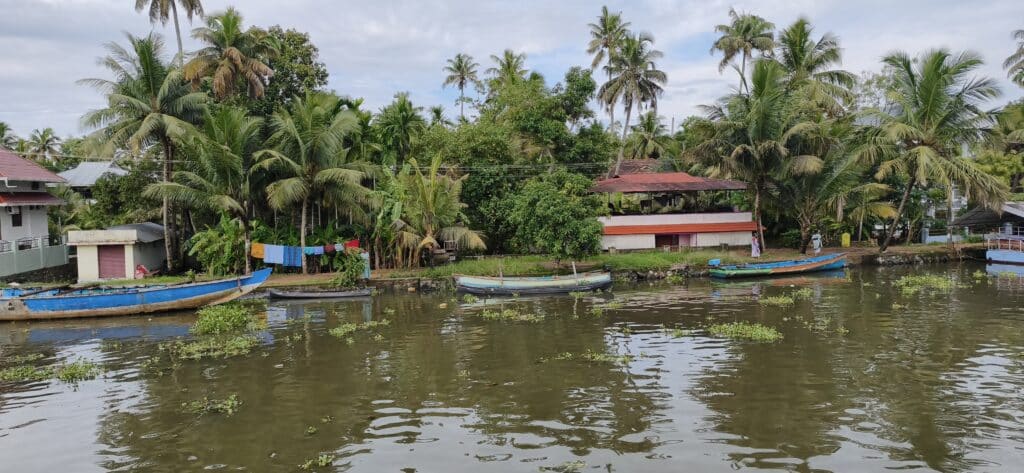
Palm trees line the water.
The first boats cross the path.
On arrival in Alleppey, the houseboat is waiting.
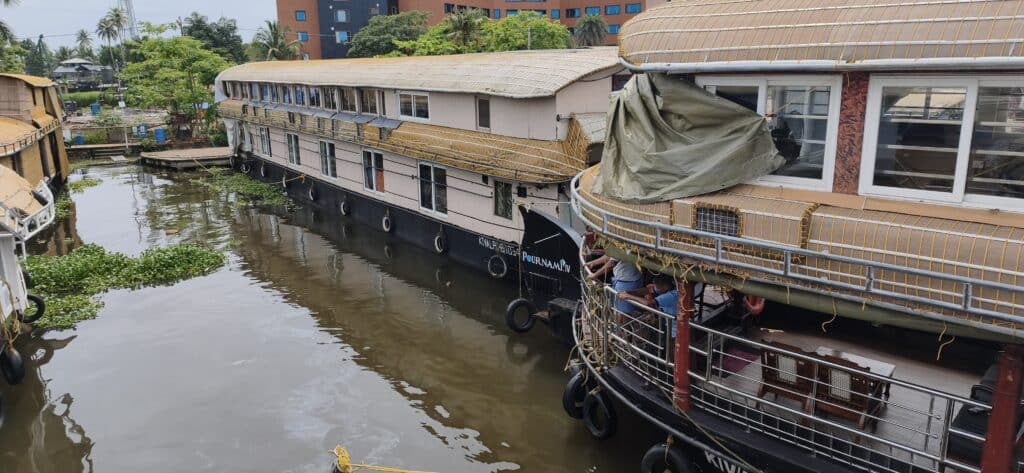
Its silhouette seems almost to belong to the landscape: long dark hull, wooden structures, curved roof, spaces open to the outside.
You board with your luggage, but also with a traveller's habit that you will soon have to abandon: that of wanting to know what comes next.
For on the backwaters, the point is precisely to stop running after what comes next.
Kerala floats by at water level
The boat is gently moving away.
No dramatic departure.
No sudden acceleration.
The movement is slow, almost silent, and it is this slowness that immediately changes the way one looks.
From the boat, Kerala is no longer a landscape that one passes through behind a car window.
It is taking place a few metres away from us.
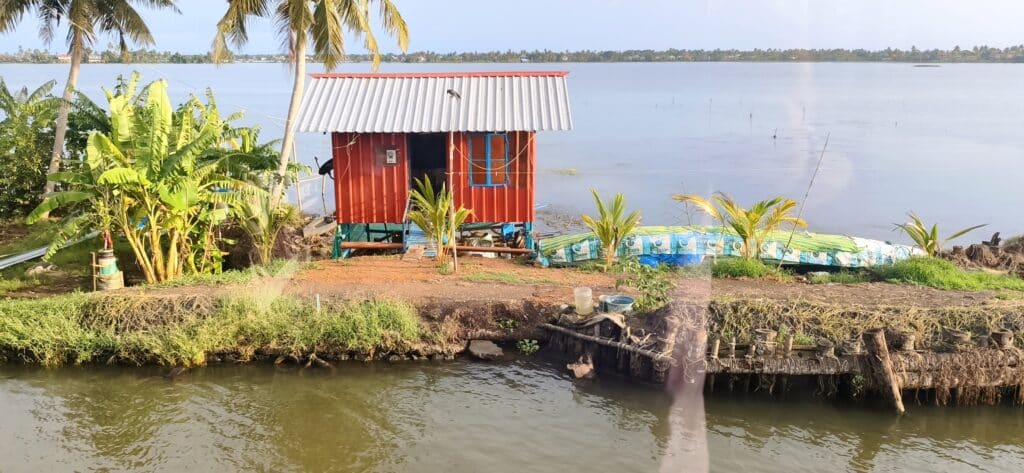
Coconut palms lean over the banks. Rice fields appear behind the canals. Houses line the water, some almost at boat level. Small boats pass in the opposite direction.
Here, water is not just a backdrop.
She organises life.
We come across some fishermen.
Boats used for daily commuting can be seen.
Children are arriving at their school.
On the banks, ordinary actions continue: washing, cooking, transporting, working, chatting, waiting.
And that's probably what makes the backwaters so fascinating.
One does not traverse a landscape artificially created for travellers.
We are crossing an inhabited territory.
Nothing spectacular, and yet you can't stop looking
The backwaters paradox is here.
If sailing were to be told as a list of activities, it would seem almost too simple.
The boat is moving.
Let's have a look.
We're having lunch.
Let's have a cup of tea.
Let's have a chat.
One photographs a reflection, a palm tree, a house, a passing boat.
Then we look again.
And yet, the hours pass without one really feeling the need to add anything.
A boat laden with goods becomes a stage.
A child waving from the bank becomes a memory.
A break of light between the coconut trees is enough to bring out the camera.
The sound of a retreating engine suddenly reminds one of how quiet the rest is.
Travel no longer seeks to provoke emotion.
He simply allows space for it to appear.
Lunch by the water
On board, the meal also contributes to this feeling of a temporary escape.
You don't get off the boat to go to a restaurant before heading straight back out for a tour.
The table is there.
The landscape continues to scroll past.
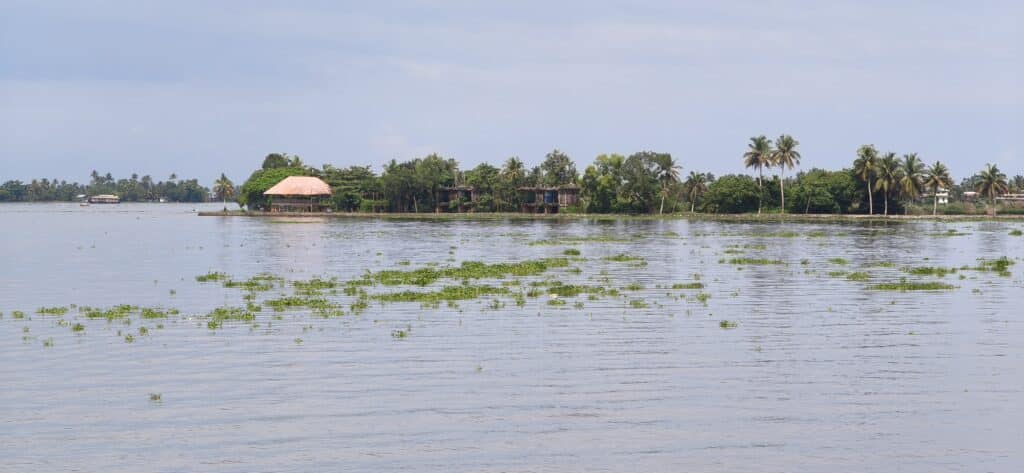
While we have lunch, the canals widen and then narrow, the banks change, and houses give way to coconut groves or fields.
The programme for our familiarisation trip also included an afternoon tea in the afternoon, a simple detail but perfectly in keeping with the spirit of the day.
We are no longer trying to optimise every minute.
We are taking our time.
And in a route as dense as the one linking Tamil Nadu and Kerala, that kind of luxury perhaps becomes one of the most precious.
A Kerala that isn't visited face-on
On the road, you often come upon things.
In front of a temple.
In front of a palace.
In front of a plantation.
In the backwaters, you discover Kerala from the side.
Life appears in fragments.
A house behind a row of palm trees.
A small pier.
A bicycle parked by the water.
A man in a boat.
Laundry drying.
A water bus that continues on its way.
A bank where someone simply seems to be waiting for the end of the day.
These are not necessarily the images you would find on the cover of a brochure.
But these are often the ones that give the most depth to a journey.
Because they do not only tell what Kerala shows visitors.
They tell a bit about the way he lives.
Stop in a village, reconnect with the earth for a few moments
Navigation can also be punctuated by a stop in a village.
After several hours spent on the water, setting foot on land again produces an almost strange effect.
The paths, the houses, the inhabitants, the sounds are found closer.
This transition serves as a reminder that the backwaters are, above all, a network of living communities, linked by water long before they became an iconic image of tourism in Kerala.
Then comes the time to get back on board.
And almost immediately, the tempo slowed down again.
A night that does not really feel like a hotel night
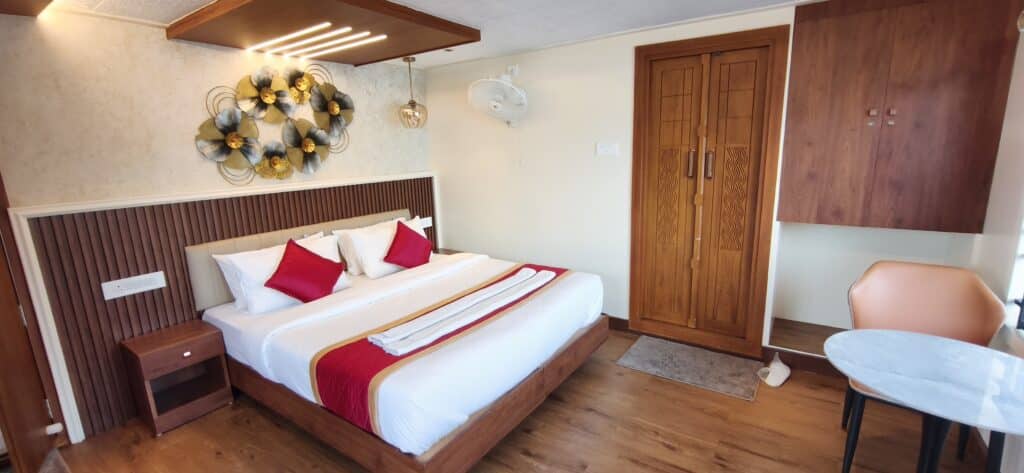
Sleeping on a houseboat also means accepting a different idea of comfort.
We are not in a conventional hotel moved onto the water.
A boat remains a boat.
The spaces, the facilities, the sensations and the daily operation reflect this reality.
And that is precisely what forms part of the experience.
With Boats & Beds, this stage was integrated into our itinerary as a genuine night of travel, rather than just a short excursion of a few hours.
Dinner takes place as the day draws to a close.
The light changes quickly over the canals.
The banks are getting darker.
The silhouettes of the coconut trees stand out against the sky.
Kerala, which we had been looking at since the afternoon, suddenly seems much quieter.
When the boat stops for the night, you realise that you're going to sleep there, surrounded by water and vegetation.
It is not necessarily the most sophisticated travel comfort.
But it is probably one of the most unusual nights.
In the evening, the light becomes the real spectacle
There is a moment, in the backwaters, when photographs almost cease to be necessary.
The sun is going down.
The water is taking on warmer tones.
The boats are becoming fewer.
A few lights are appearing in the houses.
Conversations on board are becoming quieter.
We stay seated, simply because there is no reason to move.
On many trips, you wait for the «highlight» of the day.
Here, the highlight can be exactly that: a stationary boat, a few palm trees and the light slowly fading over the water.
Then comes the morning
Waking up on a houseboat has a very special atmosphere.
Even before checking the time, you know you are not in an ordinary bedroom.
Light passes through openings differently.
Water is right there.
The day is beginning at the same pace as the previous one ended.
Softly.
We find the riverbanks again, the first trips on the canals, the sounds of everyday life starting up once more.
And so we realise that this night was not just a one-off interlude during the journey.
She modified the tempo.
The backwaters arrive at exactly the right time in the itinerary
This is perhaps one of the great strengths of this itinerary built with Namaskar India Tour.
The houseboat does not come by chance.
It arrives after several particularly eventful days.
Tamil Nadu offered its temples, its devotion, its architecture, its cities and its traditions.
Munnar brought the mountains, the tea and the freshness.
Periyar added the forest, spices and another relationship with nature.
Then the backwaters strip away almost everything that isn't essential.
There is still water left.
The scenery.
The boat.
Meals.
Conversations.
And the weather.
Ultimately, this breath gives even more value to what preceded it and to what will come afterwards.
True luxury: no longer needing to fill the day
The backwaters are often depicted as a postcard image of Kerala.
A houseboat.
Coconut trees.
Calm water.
That's true.
But it would be a shame to reduce them to that.
Their true strength lies not only in their beauty.
It lies in their ability to alter the way we travel for a few hours.
People are no longer looking to accumulate visits.
We've stopped checking what's left to do.
We accept a form of slowness that, elsewhere, might seem like wasted time.
Here, it precisely becomes the experience.
On a trip where every day brings its share of discoveries, this simplicity does you a world of good.
Another definition of the travel souvenir
When you return from South India, it is easy to talk about the monuments.
The Meenakshi temple in Madurai.
The sculptures of Mahabalipuram.
The tea plantations of Munnar.
The spices of Periyar.
But some memories are harder to name.
The light on a canal.
The gentle sound of the water against the boat.
A house glimpsed for a few seconds between two palm trees.
A meal eaten while the landscape continues to roll by.
An afternoon tea.
An evening when nobody really feels like doing anything other than watching.
The backwaters belong to this category of memories.
They do not impose themselves.
They are settling in.
And perhaps that is precisely why they stay for so long.
A night on the backwaters, to understand another Kerala
We arrive in Kerala with images of coconut palms, houseboats and traditional boats.
We leave with the understanding that the backwaters tell of something deeper.
They are talking about their relationship with water.
Everyday life.
Rhythm.
The way in which villages, families and activities continue to exist along these canals.
And they remind us that a journey does not always need to go faster, further or show more to become more intense.
Sometimes you just need to slow down.
To sit down.
And to watch Kerala go by.
To check before departure: Travel advice.
Find out more : Namaskar India Tour