
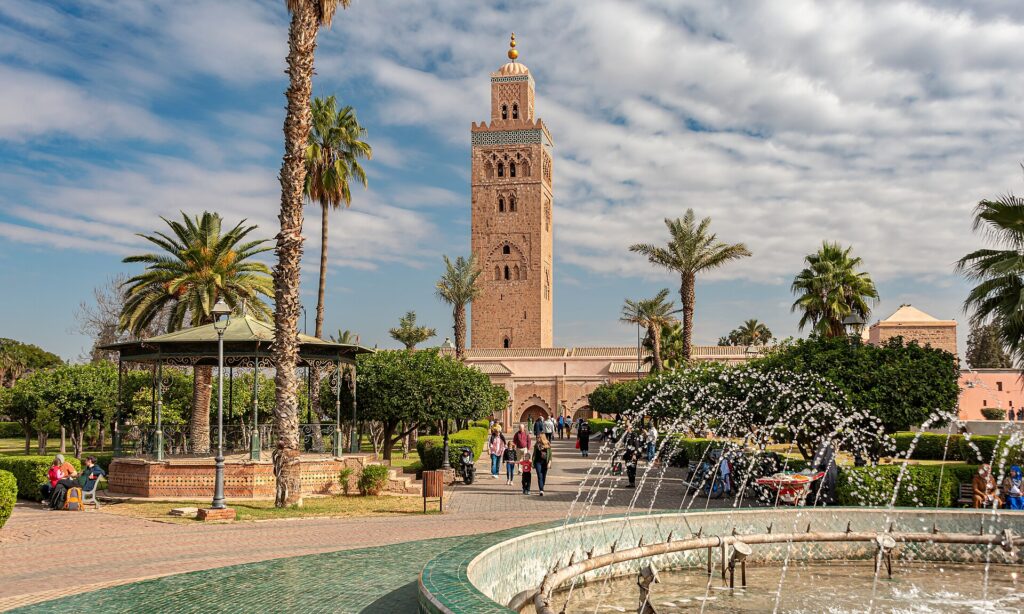
Marrakech
From the medinas to the Atlas Mountains
Link historic cities, landscapes and everyday life, giving Morocco more than a single stop.
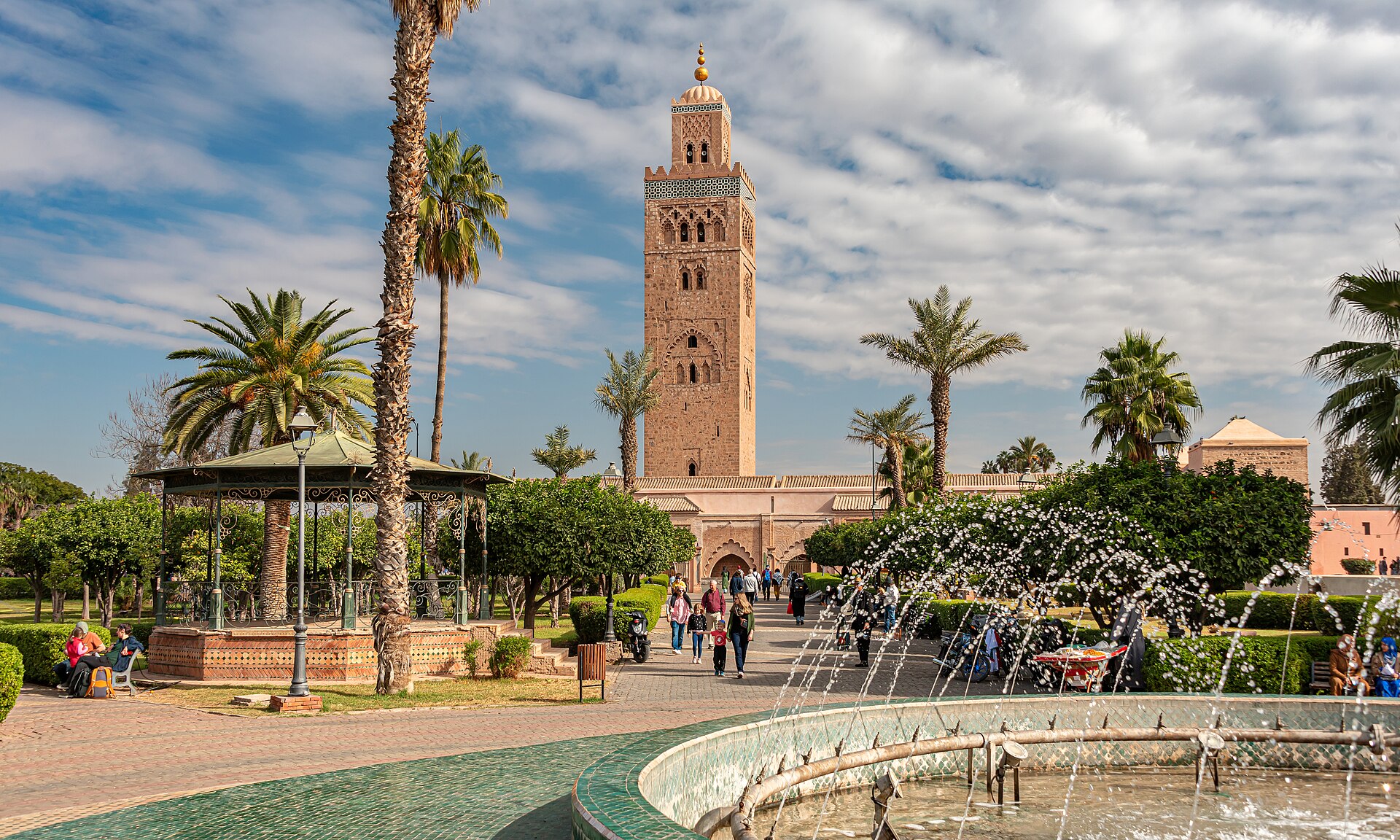
Morocco unfolds through changes of pace: the lanes of a medina, a lively square, ramparts facing the ocean, then roads climbing into the hills. Marrakech, Fez, Rabat and Essaouira offer very different starting points. On a first trip, choose a few bases and allow time for each, rather than covering too many miles.
Medinas, heritage and Atlantic stops: a guide to planning a journey through Morocco, with checked entry requirements and precautions.
Link historic cities, landscapes and everyday life, giving Morocco more than a single stop.
Regions and discoveries
Marrakech
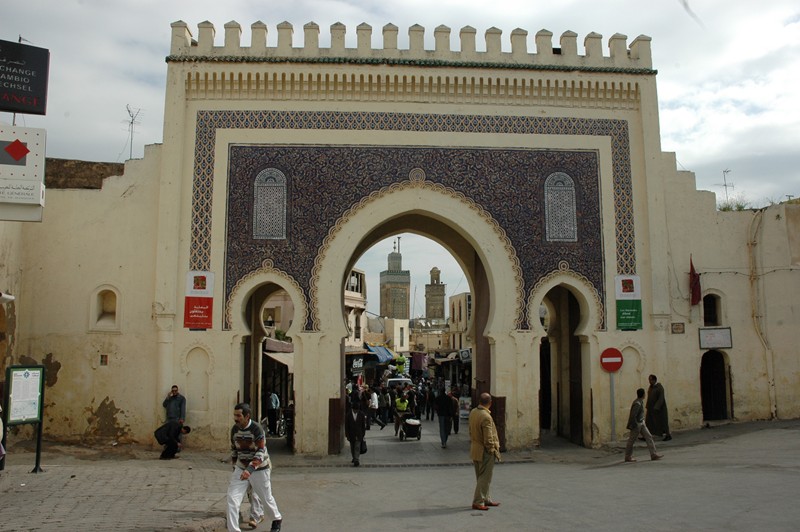
Fez and Meknes
In Fez, Bab Bou Jeloud is a useful gateway for a walk into Fes el-Bali. Pick a landmark before turning off the main lanes towards the craft workshops.
Rabat
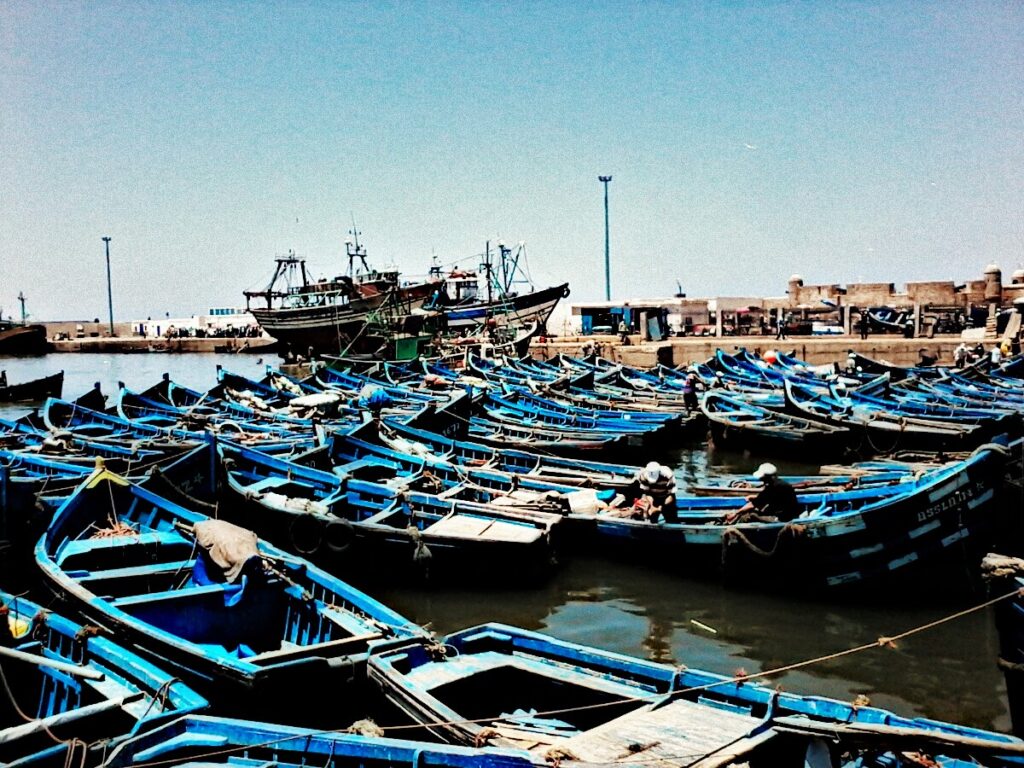
Essaouira and the Atlantic
In Essaouira, one walk can take in the harbour, the seaward ramparts and the medina. The views from the waterfront help explain the town’s position on the Atlantic coast.
No verified geolocated places in this region.
When to visit this region? →Fez and Meknes
In Fez, Bab Bou Jeloud is a useful gateway for a walk into Fes el-Bali. Pick a landmark before turning off the main lanes towards the craft workshops.
Read and locateEssaouira and the Atlantic
In Essaouira, one walk can take in the harbour, the seaward ramparts and the medina. The views from the waterfront help explain the town’s position on the Atlantic…
Read and locateThe medina brings together ramparts, gardens and monuments, with the Koutoubia as a major landmark. Exploring on foot reveals the place of traditional crafts in city life.
Two UNESCO-listed cities, best approached as separate stops rather than rushed visits between transfers.
The capital combines historic heritage with a modern city; its urban ensemble is a UNESCO World Heritage Site.
The medina of Essaouira, formerly Mogador, offers a different, coastal perspective on Moroccan heritage.
Heritage is written in materials as much as in monuments: carved wood, zellige tiles, plasterwork and gardens tell the story of a living urban tradition. An Atlantic stop or a mountain stay can complement these cultural discoveries, with plans shaped by local conditions. This guide provides a framework for an itinerary; it does not guarantee access to every site or any supplier service.
Travellers drawn to heritage, traditional crafts, cities and multi-stop journeys.
Choose two or three bases and travel during daylight.
Heritage, traditional crafts, urban walks and the coast.
Build the trip around its regions: summer heat in Marrakech, ocean influence on the coast and distinct conditions in the Atlas.
Plan around your route: a city, the coast and the mountains call for different preparations. The table presents NASA POWER climate normals for Marrakech and its plain over 1991–2020. It does not represent the altitude of the Atlas Mountains or every coastline; no universally ideal season is inferred from this single point.
Check the weather and route conditions before heading into the mountains or out to sea. Keep an alternative plan when conditions call for a change.
The documented series shows average highs close to 38°C in July and August. Reduce sightseeing during the hottest hours and allow time in the shade.
These averages do not predict weather during your stay.
Ocean influence distinguishes the coast from inland cities. Rabat's data does not automatically describe every beach in Essaouira or Agadir.
Compare the place where you will stay, not just the country.
Altitude and inland exposure change conditions. Spring and autumn are useful reference seasons for Saharan stops; mountain outings need separate checks.
Do not extend Marrakech's data to mountain summits.
Choose a region, then compare the documented local reference points. A point does not describe the whole region.
Local grid reference, not a regional average
Seasonal travel advice is not yet documented for 12 months. The available climate statistics remain accessible below.
Min.Max.
| Month | Mean minimum °C | Mean maximum °C | Rain mm |
|---|---|---|---|
| Jan | 5.2 | 17.7 | 37.6 |
| Feb | 6.0 | 19.2 | 35.2 |
| Mar | 8.0 | 22.3 | 40.5 |
| Apr | 9.7 | 24.6 | 31.2 |
| May | 12.6 | 28.5 | 13.1 |
| Jun | 16.2 | 33.2 | 4.1 |
| Jul | 20.3 | 38.0 | 5.3 |
| Aug | 20.9 | 37.7 | 5.9 |
| Sep | 17.4 | 32.4 | 13.2 |
| Oct | 14.2 | 27.5 | 24.6 |
| Nov | 9.6 | 21.9 | 46.0 |
| Dec | 6.6 | 18.7 | 35.1 |
A reference for Marrakech and its surrounding plain, not for all of Morocco: average highs approach 38 °C in July and August. The Atlas Mountains and Atlantic coast require separate regional guidance. These normals describe climate, not the weather during your stay.
NASA POWER · 1991–2020 · 2026-10-24T17:15:41+00:00
MERRA-2: 0.5° latitude × 0.625° longitude
Model-based grid estimates, not local station observations. Precipitation totals are calculated from monthly daily means and calendar days. Sea temperature, sunshine hours and rainy days are not supplied.
Requested reference point: 31.62947 / -7.98108
Local grid reference, not a regional average
Seasonal travel advice is not yet documented for 12 months. The available climate statistics remain accessible below.
Min.Max.
| Month | Mean minimum °C | Mean maximum °C | Rain mm |
|---|---|---|---|
| Jan | 5.6 | 16.4 | 89.2 |
| Feb | 6.1 | 18.0 | 77.0 |
| Mar | 8.1 | 20.9 | 84.6 |
| Apr | 9.8 | 23.1 | 68.2 |
| May | 13.1 | 27.2 | 39.8 |
| Jun | 16.8 | 32.5 | 12.3 |
| Jul | 20.7 | 37.4 | 3.5 |
| Aug | 21.5 | 37.7 | 9.2 |
| Sep | 18.1 | 32.3 | 28.9 |
| Oct | 14.6 | 27.1 | 66.7 |
| Nov | 9.7 | 20.8 | 98.2 |
| Dec | 7.1 | 17.6 | 94.7 |
Local NASA POWER statistical reference from a 0.5° × 0.625° model grid. It does not describe every landform, coastline or microclimate in the area; it is neither a forecast nor a weather guarantee.
NASA POWER · 1991–2020 · 2026-11-17T15:31:05.469988+00:00
MERRA-2: 0.5° latitude × 0.625° longitude
Model-based grid estimates, not local station observations. Precipitation totals are calculated from monthly daily means and calendar days. Sea temperature, sunshine hours and rainy days are not supplied.
Requested reference point: 34.043333 / -5.003333
Local grid reference, not a regional average
Seasonal travel advice is not yet documented for 12 months. The available climate statistics remain accessible below.
Min.Max.
| Month | Mean minimum °C | Mean maximum °C | Rain mm |
|---|---|---|---|
| Jan | 11.2 | 17.1 | 63.6 |
| Feb | 11.4 | 17.9 | 48.9 |
| Mar | 12.6 | 19.8 | 50.9 |
| Apr | 13.8 | 20.8 | 38.5 |
| May | 16.0 | 23.3 | 18.7 |
| Jun | 18.4 | 25.8 | 4.0 |
| Jul | 20.2 | 27.9 | 1.4 |
| Aug | 21.0 | 28.6 | 2.7 |
| Sep | 19.9 | 26.9 | 27.1 |
| Oct | 18.0 | 24.6 | 49.6 |
| Nov | 14.8 | 20.8 | 80.5 |
| Dec | 12.6 | 18.4 | 70.8 |
NASA POWER · 1991–2020 · 2026-10-27T11:15:22+00:00
MERRA-2: 0.5° latitude × 0.625° longitude
Model-based grid estimates, not local station observations. Precipitation totals are calculated from monthly daily means and calendar days. Sea temperature, sunshine hours and rainy days are not supplied.
Requested reference point: 34.021845 / -6.840893
Local grid reference, not a regional average
Seasonal travel advice is not yet documented for 12 months. The available climate statistics remain accessible below.
Min.Max.
| Month | Mean minimum °C | Mean maximum °C | Rain mm |
|---|---|---|---|
| Jan | 14.2 | 17.8 | 31.6 |
| Feb | 14.2 | 18.0 | 27.9 |
| Mar | 14.9 | 19.0 | 28.2 |
| Apr | 15.5 | 19.5 | 17.7 |
| May | 16.9 | 20.9 | 10.9 |
| Jun | 18.5 | 22.5 | 3.0 |
| Jul | 19.8 | 24.1 | 1.3 |
| Aug | 20.5 | 24.6 | 2.5 |
| Sep | 20.0 | 23.8 | 8.4 |
| Oct | 19.1 | 22.9 | 23.2 |
| Nov | 16.9 | 20.5 | 45.5 |
| Dec | 15.3 | 18.7 | 42.7 |
Local NASA POWER statistical reference from a 0.5° × 0.625° model grid. It does not describe every landform, coastline or microclimate in the area; it is neither a forecast nor a weather guarantee.
NASA POWER · 1991–2020 · 2026-11-17T15:31:07.334691+00:00
MERRA-2: 0.5° latitude × 0.625° longitude
Model-based grid estimates, not local station observations. Precipitation totals are calculated from monthly daily means and calendar days. Sea temperature, sunshine hours and rainy days are not supplied.
Requested reference point: 31.513023 / -9.768696
Read the medina of Marrakech through its ramparts, gardens and monuments. Look for the craft of woodwork, zellige tiles and plasterwork in the urban heritage. Make time for Fez or Meknes as a destination, rather than simply passing through. Discover Essaouira and its Atlantic-facing heritage.
Choose Marrakech and Essaouira, or Rabat and Fez, then spend several nights in each base. Arrange the transfer separately and tailor the length of the trip to what you want to explore.
An editorial suggestion, with no guaranteed duration, price or supplier service.
Indicative information to check with the official authorities before departure.
French travellers need a passport valid throughout their stay, including when travelling with an organised group. A national identity card alone is not sufficient. Have a return ticket and evidence of funds available; check your entry stamp and the requirements for your nationality.
A valid passport covering the whole stay. Each child needs their own passport; check which family documents and authorisations are required.
Check the rules for your nationality and reason for travel with the Moroccan authorities. Stays longer than 90 days require immigration formalities; a tourist stay is not a right of residence.
Before departure, check that your insurance covers medical treatment, hospital care and repatriation from Morocco. Bring your usual medicines and seek medical advice appropriate to your itinerary.
Consult up-to-date official travel advice before finalising each route. Avoid deserted areas at night and watch your belongings in cities. Border areas and remote regions need specific preparation; do not attempt an improvised crossing into Algeria, as the border is closed.
Importing a drone is prohibited without specific prior authorisation. For mountain and sea activities, check supervision, conditions and the availability of rescue services.
Ask for precise information about steps, gradients, access to rooms and vehicles. A historic medina or a hiking route presents different challenges from a recently built property.
Plan journeys around roads, terrain and local conditions. A transfer between cities is more than a distance on a map. Check schedules and accessibility with the transport operator.
Travel during daylight and allow extra time on mountain roads. Traffic can be unpredictable; inexperienced drivers may prefer arranged transport.
Group visits by neighbourhood, leave some free time and ask permission before photographing someone. Check access and opening hours rather than assuming a monument is open.
Founded in the 11th century by the Almoravids, Marrakech became a major political, economic and cultural centre. Successive dynasties added to its ramparts, gardens and monuments. Morocco’s other historic cities followed distinct paths that no single tour can fully encompass.
In Marrakech, architecture reveals a heritage of craftsmanship: zellige tiles, worked wood, plasterwork and ironwork. Taking time to notice materials and techniques can enrich a visit as much as a list of monuments.
At the table, the journey takes on a different scale. Couscous, tagines and pastilla sit alongside regional specialities: in Marrakech, tanjia cooks slowly in an earthenware pot; in Fez, khlii belongs to a tradition of dried, spiced meat. Spice stalls and pastries offer another way into the medina. Over a glass of mint tea, taking time to taste matters more than collecting addresses.
Answers to the most useful questions before you decide.
No. A passport valid throughout the stay is required, including on an organised trip.
It is better to choose a few bases and leave time for visits; roads and terrain require flexibility.
Not without specific prior authorisation. Check customs rules before packing.
No. The monthly series shown covers Marrakech and its plain for 1991–2020. It does not represent the Atlas Mountains or every coastline. Check a local forecast before mountain or sea excursions.
Editorial update: October 27, 2026
Practical information last reviewed: 2026-10-24
Ask your question: the answer draws on this guide.
Explore further with Éléonore